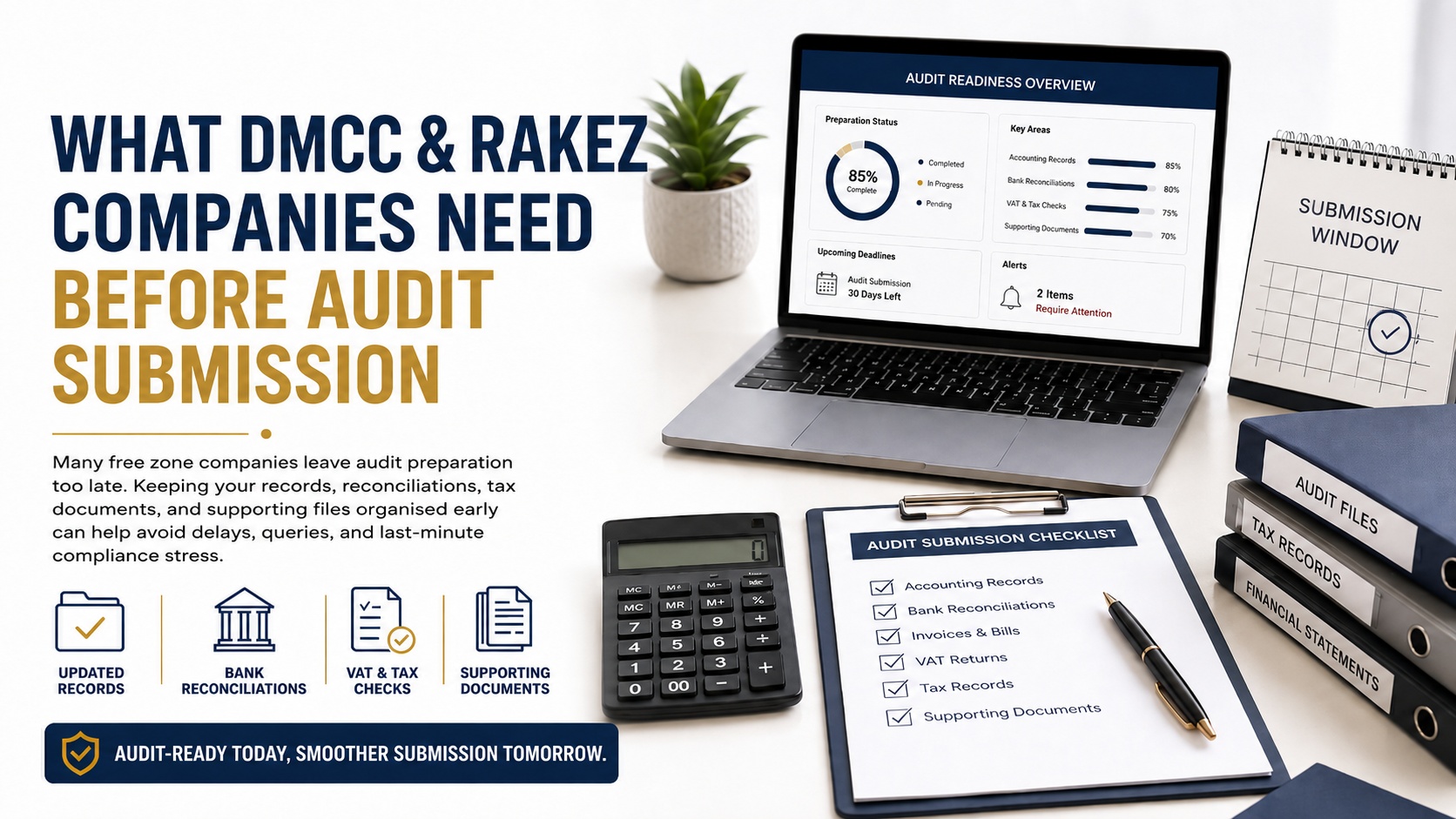
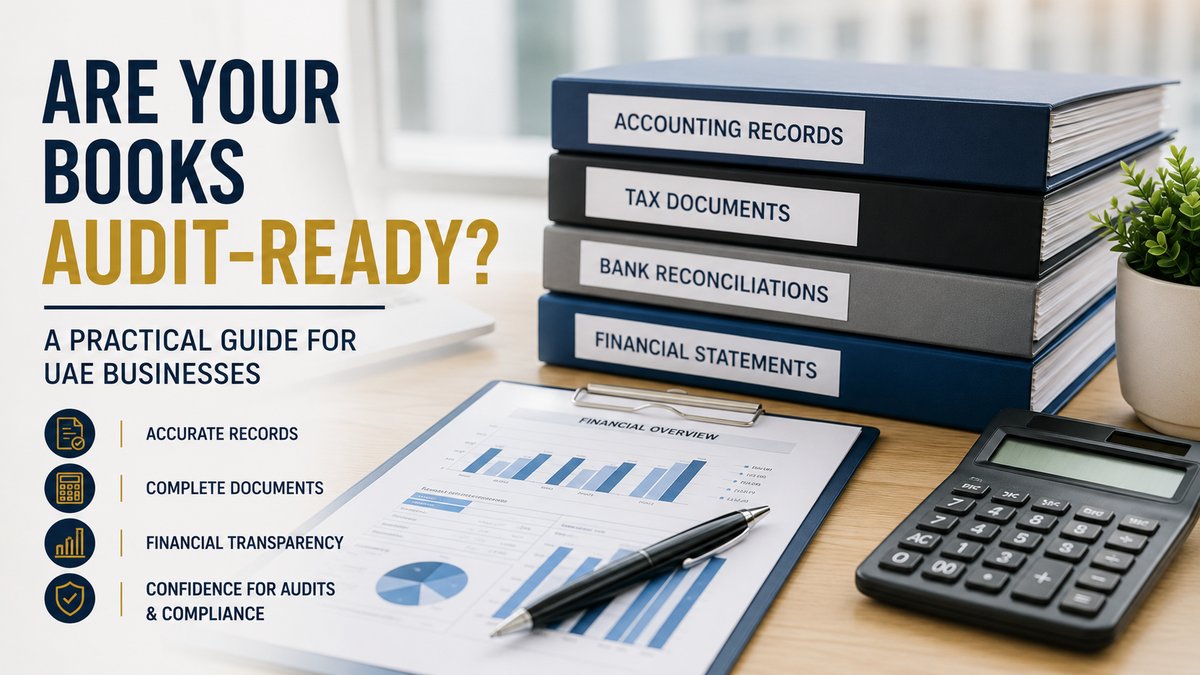
Learn how to make your business books audit-ready with proper bank reconciliation, VAT records, supplier invoices, payroll documentation, and Corporate Tax records.
Many businesses only think about audit readiness when someone asks for financial statements, supporting records, or a formal review. By that point, the pressure is already on, and the accounting team may have to search through months of invoices, bank statements, expense records, and reports to understand whether the books are complete.
Audit-ready books are not created at the end of the year. They are built through consistent accounting, proper documentation, and regular review of the numbers behind the business.
For companies in the UAE, clean books now matter for more than internal reporting. They support VAT filing, corporate tax preparation, bank requirements, investor reviews, free zone compliance, management decisions, and audit requests where applicable.
This guide explains what audit-ready books should include, where businesses often fall short, and how proper accounting records can reduce stress when financial information needs to be reviewed.
What does it mean for books to be audit-ready?
Audit-ready books are accounting records that can be reviewed, traced, and supported with proper documents. The figures in the accounts should not only be entered into an accounting system; they should also make sense when compared with invoices, bank statements, contracts, payroll records, VAT returns, and other supporting files. This does not mean every business must be under audit at all times. It means the company should keep its accounts in a condition where financial information can be checked without confusion, missing records, or unexplained balances.
When books are audit-ready, the business can answer basic financial questions with confidence. Revenue can be matched to invoices. Expenses can be supported with supplier documents. Bank balances can be reconciled. VAT records can be compared with accounting reports. Receivables and payables can be explained.
That level of organisation protects the business long before an auditor, tax adviser, bank, or authority asks for information.
Why audit readiness matters in the UAE
Business owners often think of audit as a year-end requirement, but audit readiness is much broader than that. It is about whether the company’s financial records are accurate, complete, and reliable enough to support decisions and compliance obligations.
A company may need clean books for several reasons. Banks may ask for updated financial statements during financing discussions. Free zone authorities may request accounts or audited financial statements depending on the company’s structure and requirements. Investors or partners may want a clear view of financial performance. Tax advisers may need accurate records before preparing Corporate Tax returns or reviewing VAT filings. Poor records make each of these situations harder. The company may have to delay submissions, correct old entries, explain unclear transactions, or rebuild parts of the accounts from scratch.
Audit readiness gives the business a stronger starting point. Instead of reacting under pressure, the company already has organised records and reliable reports available for review.
1. Bank accounts should be fully reconciled
Bank reconciliation is one of the first signs of whether the books are properly maintained. It shows whether the transactions in the accounting system match the activity in the company’s bank statements. When reconciliation is not done regularly, the accounts may include missing receipts, duplicated payments, unexplained transfers, unrecorded bank charges, or supplier payments that are not matched to invoices. These issues can affect more than the bank balance. They can also distort revenue, expenses, receivables, payables, and tax reports.
A business with audit-ready books should be able to show reconciled bank accounts for the relevant period. Any differences should be reviewed and explained, not left as unresolved entries in the system.
2. Sales records should match issued invoices
Revenue needs to be supported by clear sales records. This includes tax invoices, customer contracts, payment receipts, sales reports, credit notes, and any documents that explain how income was earned. Problems often appear when sales are recorded manually, invoices are issued outside the accounting system, or customer payments are received through multiple channels. In those cases, the accounting reports may not fully match the invoices or bank deposits.
For audit readiness, the business should be able to trace revenue from the sales invoice to the accounting entry and, where relevant, to the bank receipt. Credit notes, refunds, discounts, and cancelled invoices should also be recorded properly. Clear revenue records are especially important for VAT-registered businesses because sales figures may affect both accounting reports and VAT return preparation.
3. Supplier invoices should support expenses
An expense should not only appear in the bank statement. It should also be supported by a supplier invoice, receipt, agreement, or other document that explains what the payment was for. This is where many businesses face problems during a financial review. Payments may be recorded, but the supporting documents may be missing. Expenses may be posted under vague categories. Supplier invoices may not match payment amounts. Some costs may be personal in nature but recorded as business expenses.
Audit-ready books require a clear connection between the expense, the supplier document, and the accounting entry. This helps the business support its financial statements, review VAT input claims, and prepare for Corporate Tax filing. The stronger the expense documentation, the easier it is to defend the numbers in the accounts.
4. VAT records should agree with accounting reports
VAT records and accounting reports do not need to be identical in every line item, but any differences should be understood and explainable.
A common issue is that VAT returns are prepared separately from the accounting records. Over time, this can create differences between sales reports, purchase records, VAT ledgers, and filed returns.
For a business to be audit-ready, VAT records should be reviewed alongside the accounts. Output VAT, input VAT, credit notes, reverse charge entries, import VAT, and VAT payable or refundable should be checked against the supporting documents. This helps identify errors before they become larger compliance issues. It also gives the company a clearer view of whether VAT filings are supported by the records behind them.
5. Payroll and staff costs should be documented
Payroll is often one of the largest recurring costs in a business, so it needs proper documentation. Salary payments, employment contracts, allowances, bonuses, reimbursements, visa costs, medical insurance, and end-of-service provisions should be recorded clearly.
Where WPS applies, payroll records should also be consistent with salary payment records and employee files. Any staff advances, reimbursements, or owner-approved payments should be separated from normal salary expenses.
Audit readiness becomes difficult when payroll entries are posted without enough detail or when employee-related payments are mixed with other expenses.
Clean payroll documentation supports accurate reporting and reduces confusion when reviewing staff costs at year-end.
6. Receivables and payables should be reviewed
Accounts receivable shows what customers owe the business. Accounts payable shows what the business owes to suppliers and other parties. Both balances need regular review because they can quickly become inaccurate if invoices, payments, credit notes, or adjustments are not recorded properly.
Old customer balances may remain in the books even after payment has been received. Supplier balances may include duplicated bills or payments that were not matched correctly. Some balances may no longer be recoverable or payable, but they continue to appear in the accounts because no one has reviewed them.
Audit-ready books should show receivables and payables that reflect the real position of the business. Old balances should be investigated, major differences should be explained, and supporting documents should be available.
7. Personal and business transactions should be separated
Owner-managed companies often struggle with mixed transactions. A business account may be used for personal payments, owner withdrawals, family expenses, or costs that are not clearly related to the company. These transactions create accounting and tax complications if they are not classified correctly. They may affect expenses, shareholder balances, VAT claims, and the overall reliability of the financial statements.
A business with clean books should clearly separate business expenses from personal payments. Owner withdrawals, director expenses, shareholder loans, and personal reimbursements should be recorded in the right accounts instead of being left under general expense categories. This makes the books easier to review and reduces the risk of unsupported costs being treated as business expenses.
8. Supporting documents should be easy to find
Good accounting is not only about entering numbers correctly. The business also needs a reliable way to store and retrieve documents.
Invoices, contracts, bank statements, receipts, tax records, payroll files, lease agreements, loan documents, and major supplier agreements should be organised in a way that allows the business to find them quickly.
A common problem is that records are scattered across email inboxes, WhatsApp messages, folders, desktops, and paper files. When a review is needed, the team spends more time searching for documents than reviewing the actual accounts. Document control is a major part of audit readiness. A simple filing system can save time, reduce confusion, and make financial reviews much smoother.
9. Accounting reports should be reviewed regularly
A business should not wait until year-end to review its profit and loss statement, balance sheet, receivables, payables, VAT position, and cash flow.
Regular review helps detect issues while they are still fresh. A wrong entry can be corrected quickly. A missing invoice can be requested from the supplier.
An unusual expense can be checked before it affects reporting. A customer balance can be followed up before it becomes too old.
Monthly or quarterly reviews give business owners a clearer view of performance and reduce the pressure of year-end cleanup. Audit-ready books are usually the result of regular review, not last-minute correction.
10. Corporate Tax records should be complete
Corporate Tax has made proper record keeping even more important for businesses in the UAE. A Corporate Tax return is based on the company’s financial records, and those records should support the income, expenses, adjustments, and tax position reported. Businesses should keep financial statements, accounting ledgers, invoices, bank records, payroll documents, contracts, and other documents relevant to the tax period. These records may be needed to support the information submitted to the Federal Tax Authority.
Corporate Tax filing becomes much harder when the books are incomplete or when the company cannot explain the numbers behind the return.
Good accounting records help the business prepare for filing, respond to questions, and reduce the risk of errors caused by missing information.
Signs your books may not be audit-ready
A business may need an accounting review if it is dealing with any of the following issues:
Bank accounts have not been reconciled recently.
Supplier invoices are missing or stored in different places.
VAT returns do not match accounting reports.
Personal and business expenses are mixed.
Old receivables and payables have not been reviewed.
Payroll records are incomplete or unclear.
Financial statements are only prepared at year-end.
The business cannot easily find supporting documents.
Corporate Tax preparation has started, but the accounts are not updated.
Management reports do not match the business owner’s understanding of performance.
These issues are common, but they should not be ignored. The longer they remain unresolved, the more difficult and costly they become to fix.
How AMCME can help
Audit-ready books give business owners confidence. They make tax filing smoother, support better decisions, improve compliance, and reduce stress when financial records need to be reviewed. The best time to prepare is not when a deadline arrives. It is while the business still has time to correct errors, organise records, reconcile accounts, and review reports properly.
Contact AMCME today to check whether your books are audit-ready.