Can a natural person deregister from UAE corporate tax if turnover falls below AED 1 million? Learn what to check before cancelling your tax registration.
For many freelancers, consultants, sole establishment owners, and individual business owners in the UAE, the AED 1 million corporate tax threshold raises a very practical question:
If my turnover falls below AED 1 million, can I deregister from corporate tax?
The short answer: not automatically.
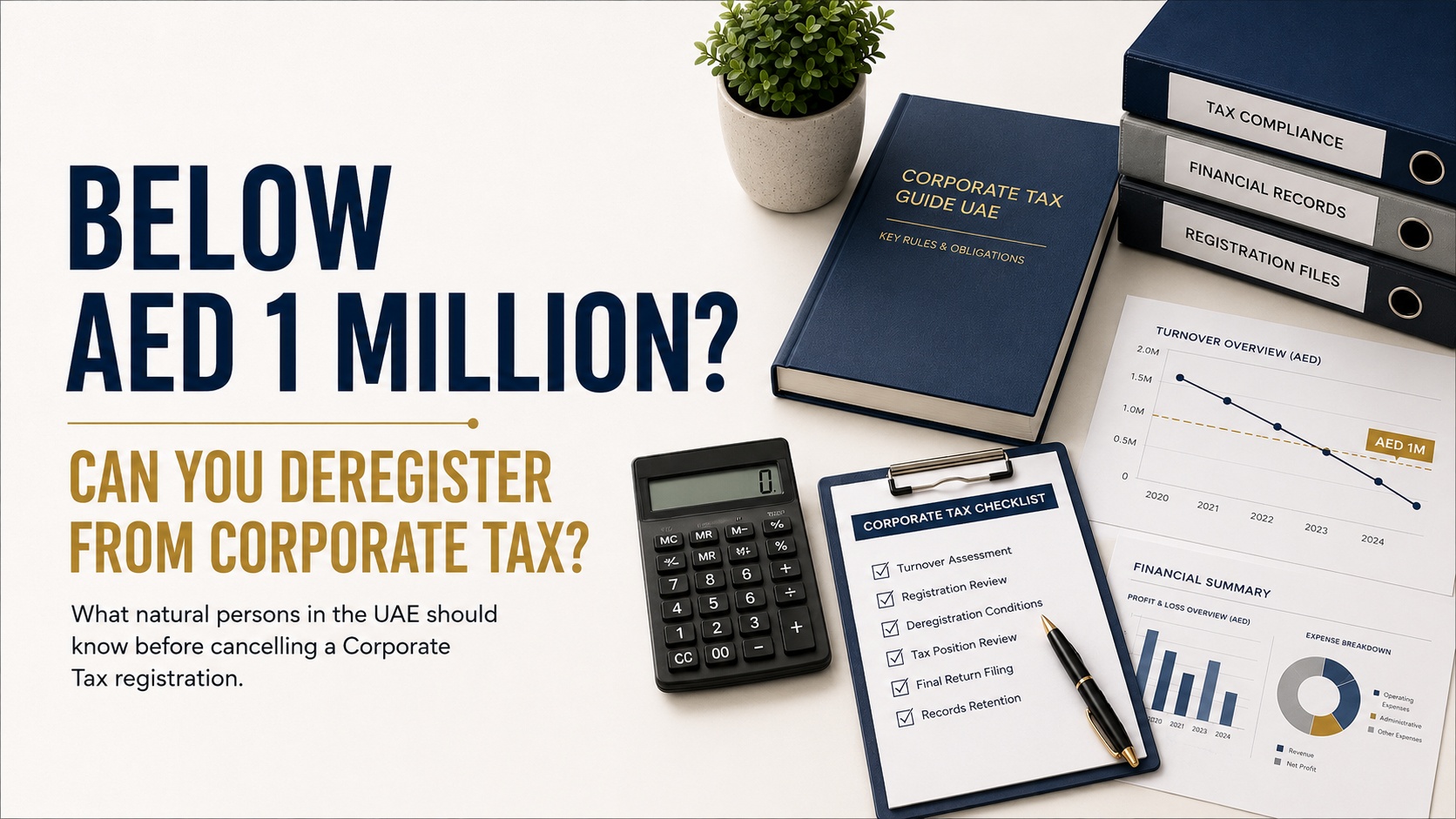
The AED 1 million threshold is used to determine when a natural person becomes subject to UAE corporate tax. But once a person is already registered, a later drop in turnover does not automatically cancel the registration.
In most cases, the more important question is whether the business or business activity has actually stopped.
If the business is still active, if invoices are still being issued, or if income is still being earned from business activity, deregistration should not be treated as a simple next step.
This guide explains what the AED 1 million threshold means, when deregistration may apply, and what natural persons should check before cancelling their corporate tax registration.
What does the AED 1 million threshold mean for natural persons?
A natural person is an individual. For corporate tax purposes, this may include a freelancer, consultant, sole establishment owner, self-employed professional, or an individual carrying out business activity in the UAE.
A natural person becomes subject to UAE corporate tax when they conduct a business or business activity in the UAE and their total turnover from that business or business activity exceeds AED 1 million within a calendar year. This threshold applies to business turnover. It should not be confused with every type of personal income.
For example, wages, personal investment income, and real estate investment income are not treated as business or business activity income for this purpose.
That distinction matters.
Someone may earn a salary and also run a small licensed activity on the side. The salary does not automatically become business turnover. The corporate tax review should focus on the income earned from the business or business activity.
So, can you deregister if turnover falls below AED 1 million?
A drop in turnover below AED 1 million does not automatically mean you can deregister from corporate tax.
This is where many natural persons get confused.
The AED 1 million threshold helps decide when registration becomes required. It does not mean that an existing registration disappears the moment turnover drops below that amount.
If your business activity is still continuing, you may still need to keep the registration active and meet any filing obligations linked to that registration.
For example, a consultant may have crossed AED 1 million in one calendar year, registered for corporate tax, and then earned less in the next year.
That lower turnover may affect the person’s tax position, but it does not automatically mean deregistration is correct.
The business needs to be reviewed properly before any application is made.
When does corporate tax deregistration usually apply?
Corporate tax deregistration is usually relevant when the business or business activity has stopped or when there is another valid reason for deregistration.
It is a formal process submitted through EmaraTax. It is not something that happens automatically because income has reduced.
A natural person should be careful before applying for deregistration if any part of the business is still active.
This may include situations where the person is still:
• issuing invoices
• serving clients
• renewing a trade license or freelance permit
• receiving business income
• advertising services
• keeping the business open for future work
A slow year is not the same as a closed business. If the activity has reduced but not stopped, deregistration may not be the right step.
Quick comparison: lower turnover vs stopped business
Situation | What it may mean |
|---|---|
Turnover fell below AED 1 million, but the business is still active | Deregistration should not be assumed |
The license is still active and invoices are still being issued | The business activity may still be ongoing |
The person stopped taking clients but the license remains active | The position should be reviewed before applying |
The business activity has fully ceased | Deregistration may be relevant |
The person is registered but has no tax payable | A tax return may still be required |
This is why the decision should not be based only on turnover. The status of the business activity matters.
Do you still need to file a corporate tax return?
If your corporate tax registration is still active, filing obligations should not be ignored.
Many people assume that if there is no corporate tax to pay, there is nothing to submit. That is not always correct.
A person may still need to file a corporate tax return even where no tax is payable.
This can happen when the registration remains active, the tax period still needs to be closed, or the FTA records still show the person as registered.
Filing and payment are not the same thing.
Payment is about whether tax is due.
Filing is about reporting the position correctly.
Missing a filing requirement can create problems later, especially if the person needs a clean tax record for banking, license renewal, audit work, visa matters, or future business activity.
Example: freelancer whose income dropped below AED 1 million
Take a freelance consultant who earned more than AED 1 million in business turnover in 2024 and registered for corporate tax.
In 2025, the same consultant earns AED 650,000. The consultant is still working with clients, issuing invoices, and renewing the freelance permit. In this case, the drop in turnover does not automatically mean the person should deregister. The activity is still ongoing. The correct step would be to review the corporate tax position, check whether a return is still due, and confirm what the active registration requires.
Deregistration should only be considered if there is a valid basis for it.
Example: business activity has fully stopped
Now take another person who registered for corporate tax after crossing the AED 1 million threshold but later stopped the business completely. The license was cancelled, no clients are being served, no invoices are being issued, and no business income is being received.
In this case, corporate tax deregistration may be relevant. However, it still needs to be handled through the proper process. The person may also need to check whether any final return, supporting documents, or outstanding compliance steps are required.
Closing the business activity does not mean ignoring the tax record.
It means closing it correctly.
What should you check before applying for deregistration?
Before applying to deregister from corporate tax, a natural person should review a few basic points.
First, check whether the business activity has actually stopped. If you are still working with clients, selling services, or earning business income, the activity may still be active.
Second, check your license or permit status. If the license is still active, the business may still appear active from a compliance perspective.
Third, check whether any corporate tax return is still due. Even if no tax is payable, the filing requirement may still exist.
Fourth, review your invoices and income records. These will help confirm whether the activity has reduced or actually ceased.
Finally, confirm whether you have supporting documents for deregistration. Since deregistration is a formal application, it should be supported by the right records.
Common mistakes to avoid
The first mistake is assuming that turnover below AED 1 million automatically cancels corporate tax registration.
It does not.
The second mistake is applying for deregistration while the business is still operating.
This can create issues if the person continues to invoice clients or receive business income after deregistration.
The third mistake is ignoring a tax return because no tax is payable. No tax payable does not always mean no filing required.
The fourth mistake is mixing personal income with business turnover. Salary, personal investment income, and business revenue should be reviewed separately.
The fifth mistake is waiting until the deadline to check the position. By then, there may be little time to correct records, prepare documents, or file properly.
What should natural persons do now?
If you are already registered for UAE Corporate Tax and your turnover has dropped below AED 1 million, do not rush to deregister.
Start by reviewing your business activity.
Ask:
• Am I still issuing invoices?
• Am I still serving clients?
• Is my license or freelance permit still active?
• Am I still receiving business income?
• Do I still have a corporate tax return to file?
• Has the business actually stopped, or has income only reduced?
These answers will help determine the correct next step.
FAQs
Can I deregister from UAE corporate tax if my turnover falls below AED 1 million?
Not automatically. A drop in turnover does not by itself cancel an active corporate tax registration. The business position should be reviewed before applying for deregistration.
Does the AED 1 million threshold apply to salary income?
No. The AED 1 million threshold applies to turnover from business or business activity. Wages are not treated as business or business activity income for this purpose.
If no corporate tax is payable, do I still need to file?
You may still need to file if your corporate tax registration is active. Filing obligations should be checked even where the tax payable is nil.
When is corporate tax deregistration usually relevant?
Deregistration is usually relevant when the business or business activity has ceased or when another valid deregistration reason applies.
Should freelancers check their corporate tax status every year?
Yes. Freelancers and individual business owners should review their turnover, license status, invoices, and filing obligations regularly, especially after crossing the AED 1 million threshold.
Final answer
A natural person in the UAE should not assume they can deregister from corporate tax simply because turnover falls below AED 1 million.
The AED 1 million threshold is important for determining when corporate tax applies to natural persons. But once registration is active, deregistration depends on the person’s actual business position.
If the business or business activity has stopped, deregistration may be relevant.
If the business is still active, the person may still need to keep the registration active and file any required corporate tax return.
Before cancelling your corporate tax registration, make sure the position is reviewed correctly.
We can help you check whether your registration should remain active, whether a return is still due, and what steps should be taken before applying for deregistration. Contact us today.