Learn why GoAML registration and AML compliance matter for UAE businesses, which DNFBPs may need to comply, and how missing requirements can affect banking.
Many business owners in the UAE think anti-money laundering compliance only applies to banks, exchange houses, and financial institutions. That assumption can be costly.
Certain non-financial businesses are also required to follow AML rules, register on the goAML portal, maintain proper compliance records, and report suspicious activity where required. These businesses are known as Designated Non-Financial Businesses and Professions, often referred to as DNFBPs.
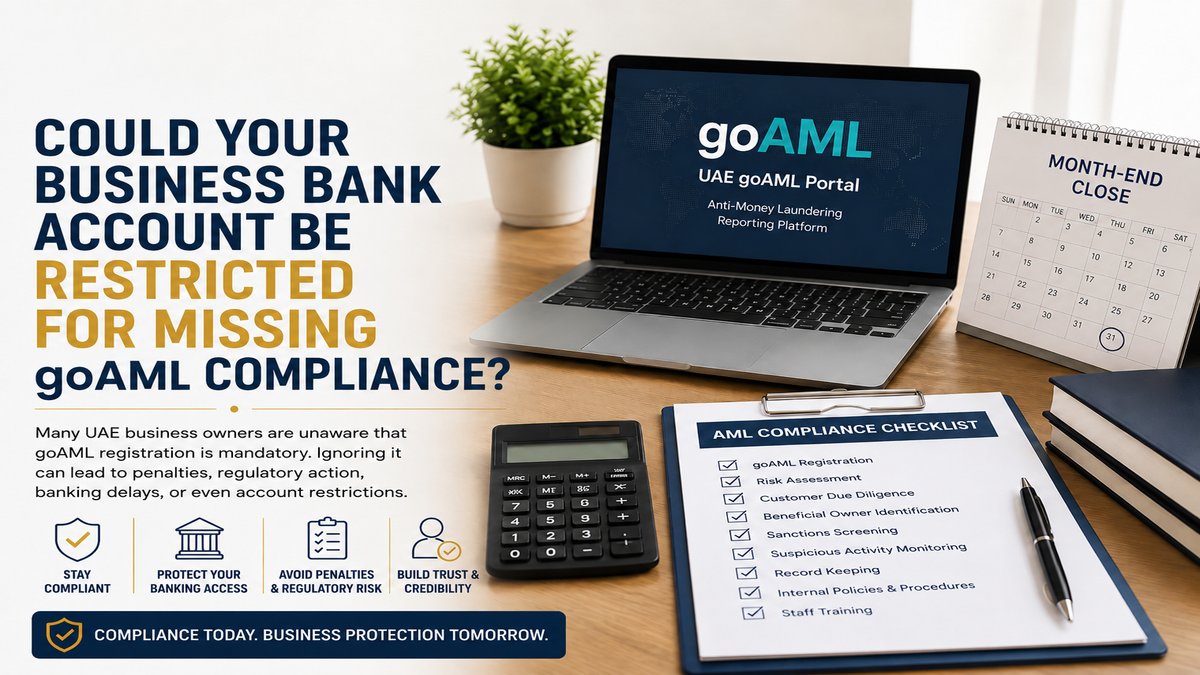
For companies that fall under this category, goAML is not just another government registration. It is part of the UAE’s anti-money laundering and counter-terrorism financing framework. If a business ignores it, the issue can affect more than paperwork. It may lead to penalties, regulatory action, banking delays, account restrictions, or difficulty opening and maintaining a business bank account.
This is why business owners should not wait until a bank, regulator, or compliance officer asks for proof. If your activity falls under AML requirements, your goAML position should be reviewed before it becomes an operational problem.
What is GoAML in the UAE?
goAML is the reporting platform used by the UAE Financial Intelligence Unit. It allows regulated businesses to submit reports related to suspicious transactions and suspicious activities.
For Designated Non-Financial Businesses and Professions, registration on the goAML portal is mandatory. The Ministry of Economy explains that DNFBPs are required to register and use the platform to file suspicious transaction reports or suspicious activity reports where applicable.
This requirement exists because certain business activities can be exposed to money laundering, terrorist financing, sanctions, and other financial crime risks. The purpose is not to accuse every business of wrongdoing. It is to make sure companies in higher-risk sectors have a proper system for identifying, reviewing, and reporting suspicious activity.
Which businesses may need GoAML registration?
GoAML registration is especially relevant for businesses that fall under the DNFBP category.
This may include companies involved in real estate brokerage, precious metals and stones, accounting and audit services, corporate service providers, trust and company formation services, and certain legal consultancy activities when they carry out specified transactions for clients.
The exact obligation depends on the nature of the business activity, license, services provided, and the transactions handled. A company should not assume it is exempt simply because it is not a bank or financial institution.
Many business owners first hear about goAML when they are opening a bank account, updating compliance documents, renewing internal policies, or responding to a request from a regulator or bank. By that point, the process may become urgent.
A better approach is to review the business activity early and confirm whether goAML registration, AML policies, risk assessment, customer due diligence, sanctions screening, or suspicious transaction reporting procedures apply.
How can GoAML affect banking?
Banks in the UAE are required to apply strict customer due diligence and ongoing monitoring. When a bank reviews a business account, it may request documents that show the company understands and manages its AML obligations. For DNFBPs, this can include evidence of goAML registration, AML policies, customer risk assessment, beneficial owner information, source of funds documentation, transaction records, and compliance procedures.
If the bank cannot verify the company’s compliance position, it may delay onboarding, request more documents, restrict certain transactions, or review the account more closely. In some cases, businesses may experience account access issues while compliance questions are being resolved.
This does not mean GoAML non-registration automatically freezes every business bank account. The risk is more practical than that. If a business is required to comply and cannot show that it has done so, the bank may treat the company as a higher compliance risk.
For a business that depends on its bank account for payroll, supplier payments, rent, imports, client receipts, or tax payments, even a temporary restriction can create serious disruption.
Why many business owners miss this requirement
One reason business owners miss goAML compliance is that AML terminology sounds technical. Words like DNFBP, suspicious transaction reporting, customer due diligence, sanctions screening, and risk assessment can feel like they belong only to large financial institutions.
In reality, the rules also apply to specific non-financial sectors because those sectors may handle high-value transactions, client funds, ownership structures, property deals, precious assets, or company setup activities.
Another reason is that some businesses focus only on license renewal, VAT, corporate tax, and bookkeeping. Those are important, but they are not the full compliance picture.
A company may be up to date with tax filings and still have a gap in AML compliance. That gap may not be visible every day, but it can become a serious issue when the business is reviewed by a bank, authority, auditor, or potential partner.
What happens if a business ignores GoAML?
Ignoring goAML can expose a business to several risks. The Ministry of Economy has previously announced enforcement action against DNFBP establishments that failed to register on the goAML system, including temporary suspension of operations.
Beyond regulatory action, the business may face practical banking and operational issues. A bank may ask for compliance evidence during account opening or periodic review. If the business cannot provide it, the bank may delay services, request further documents, or take a more cautious approach to the account.
The company may also struggle to respond properly if it identifies suspicious activity but does not have a reporting process in place.
This is why goAML should not be treated as a one-time registration only. Registration is an important step, but it should be supported by internal AML procedures, customer due diligence, sanctions checks, staff awareness, and proper record keeping.
Registration alone is not enough
Some business owners think that once goAML registration is complete, the compliance issue is solved. That is not the right approach.
goAML registration gives the business access to the reporting platform, but the company still needs an AML compliance structure that matches its risk exposure.
This may include appointing a compliance officer or responsible person, preparing AML/CFT policies, conducting customer due diligence, identifying beneficial owners, assessing customer and transaction risk, screening against sanctions lists, keeping records, and filing reports where required.
A business should also train relevant staff so they understand what suspicious activity may look like and when a matter needs to be escalated internally.
The goal is not to create unnecessary paperwork. The goal is to make sure the company can show that it has taken reasonable steps to identify and manage AML risks.
Common signs your business should review its GoAML position
A business should review its goAML and AML compliance position if any of the following apply:
The company operates in real estate, accounting, audit, company formation, precious metals, precious stones, or certain legal consultancy activities.
The bank has requested AML documents or compliance evidence.
The business has never checked whether it falls under the DNFBP category.
The company does not have a written AML policy.
Customer due diligence is done informally or not documented.
Beneficial owner information is not clearly recorded.
Staff do not know how to identify or escalate suspicious activity.
The company has high-value transactions but no formal risk review.
The business has not registered on goAML despite falling under a regulated activity.
Records are scattered and difficult to retrieve during compliance reviews.
These are not issues to leave until a bank account review or regulatory request. They are signs that the business needs to strengthen its compliance position
.
What documents may be needed for GoAML and AML compliance?
The exact documents depend on the business activity and compliance requirements, but companies may need to prepare several key records.
These may include trade license details, owner and manager information, Emirates ID and passport copies, beneficial owner information, company structure details, AML policy documents, customer due diligence records, risk assessment files, sanctions screening records, transaction review documents, and internal reporting procedures.
A business may also need to show that it understands when suspicious activity should be reported and how reports are submitted through the goAML portal.
Keeping these documents organized helps the business respond faster when a bank, authority, or adviser asks for evidence.
How to reduce GoAML and AML compliance risk
The first step is to confirm whether the business falls under the DNFBP category. This should be checked based on the company’s actual activity, not only the general wording of the trade licence.
Once the obligation is confirmed, the company should complete goAML registration if required and set up a basic AML compliance framework. This should include policies, risk assessment, customer checks, sanctions screening, record keeping, and internal escalation procedures.
The business should also review its bank compliance documents. If a bank asks for AML evidence, the company should be ready to provide clear and organised information rather than trying to prepare everything under pressure.
Regular review is also important. A business may change its services, clients, transaction value, ownership structure, or risk exposure over time. AML compliance should be updated when the business changes.
Why business owners should act early
GoAML compliance becomes more stressful when it is handled only after a problem appears. If a bank account is under review, a transaction is delayed, or a regulator requests information, the business may have very little time to organize documents and correct gaps.
Acting early gives the company more control. It allows the business to check whether registration applies, prepare the right documents, set up internal procedures, and reduce the chance of avoidable disruption.
For business owners, the real issue is not only whether a fine may apply. The bigger concern is business continuity. If banking access is delayed or restricted, the company may struggle to pay staff, receive client funds, settle supplier invoices, or keep operations running smoothly.
That is why goAML and AML compliance should be treated as part of business protection, not just regulatory paperwork.
Get GoAML compliance support in the UAE
GoAML registration and AML compliance can feel technical, especially for business owners who are already managing VAT, Corporate Tax, payroll, accounting, and daily operations.
The safest approach is to review your business activity, confirm whether DNFBP obligations apply, and prepare the necessary compliance documents before a bank or authority requests them.
If your business has not checked its goAML position yet, contact AMCME today to review your compliance requirements and reduce avoidable banking or regulatory risks.