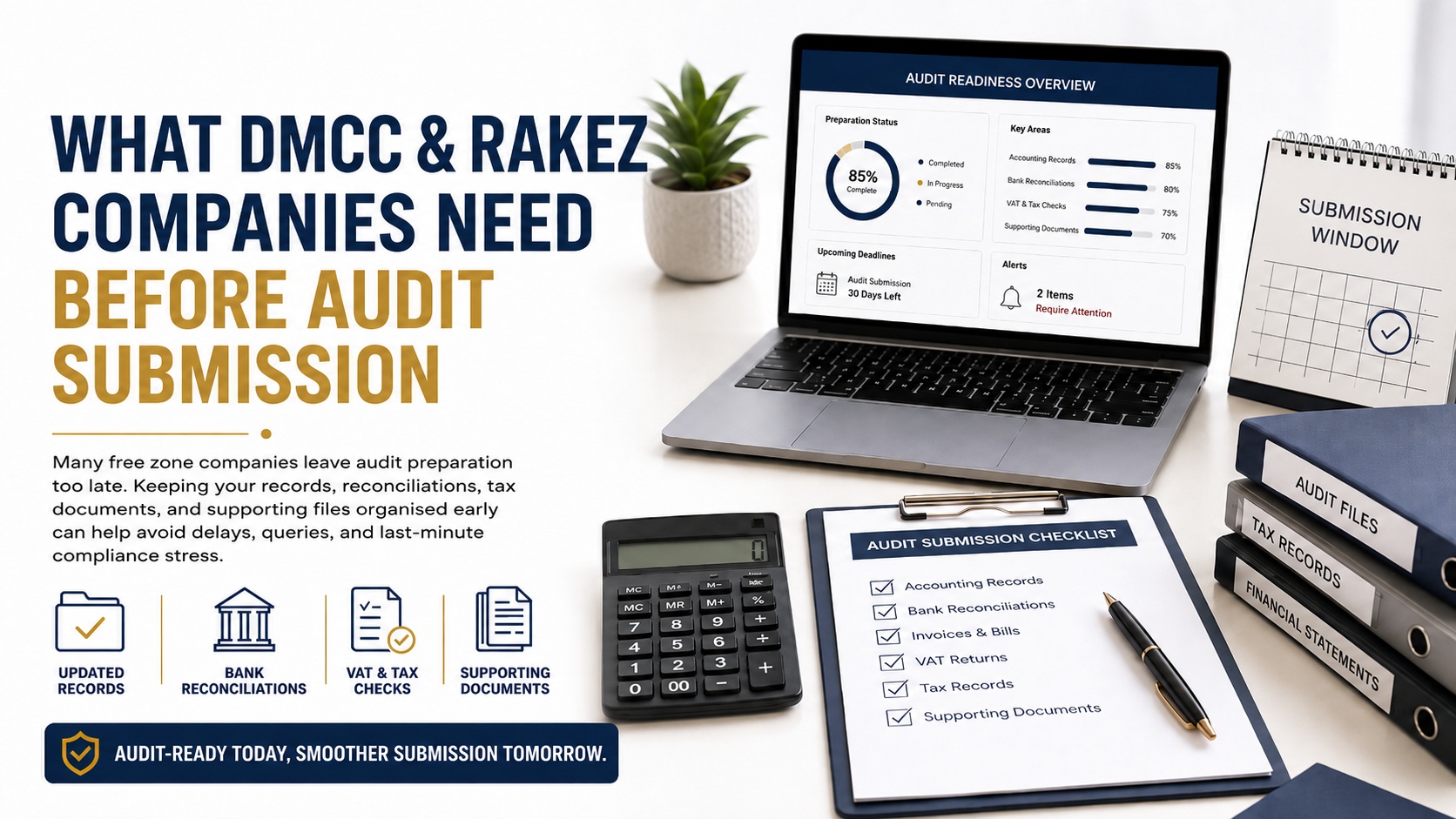
Learn what DMCC and RAKEZ companies need before audit submission, including required documents, timelines, accounting records, VAT checks, and common mistakes to avoid.
For companies registered in DMCC or RAKEZ, audit submission is not just a year-end formality. It is part of maintaining proper compliance, supporting license requirements, and proving that the company’s financial records are accurate and complete.
Many businesses wait until the deadline is close before preparing their audit file. That is usually when problems appear. Missing invoices, unreconciled bank accounts, unclear shareholder transactions, incomplete expense records, and mismatched VAT reports can all delay the audit process.
A smoother audit starts much earlier.
Whether your company operates in DMCC, RAKEZ, or another UAE free zone, the goal is the same: keep your accounts organized, prepare supporting documents, and give your auditor a clear financial picture of the business.
This guide explains what DMCC and RAKEZ companies should prepare before audit submission, what documents are usually required, and the common issues that cause unnecessary delays.
Why Audit Submission Matters for DMCC and RAKEZ Companies
Audit submission helps confirm that a company’s financial statements reflect its actual business position. It also supports transparency for shareholders, banks, regulators, and other stakeholders.
For DMCC companies, audited financial statements and the signed and stamped audited financial statements summary sheet must be uploaded through the DMCC Member Portal within six months after the end of each financial year. RAKEZ also requires companies to submit audited financial statements within six months from the end of the financial year. According to RAKEZ, companies that fail to submit on time may face a fine of AED 2,500.
This is why audit preparation should not be left until the final month. The audit depends on the quality of the company’s accounting records, not just the final report.
DMCC Audit Submission: What Companies Should Know
DMCC member companies are required to submit audited financial statements through the DMCC Member Portal. The submission includes the audited financial statements and the audited financial statements summary sheet, signed and stamped by the auditor.
DMCC also states that it is the responsibility of each member company to ensure that its appointed auditor is registered as an approved auditor with DMCCA and listed in the Approved Auditors List.
Before submission, the auditor’s details must be entered in the portal, and the uploaded documents are reviewed through the application process. DMCC also reserves the right to request additional documents at any time. For businesses, this means the audit file should be accurate, complete, and easy to verify before the portal submission is made.
RAKEZ Audit Submission: What Companies Should Know
RAKEZ companies are required to prepare and submit audited financial statements for every financial year. RAKEZ also states that financial statements should be prepared by auditing firms enrolled in the RAKEZ-approved auditors list.
The audit submission deadline is generally within six months from the company’s financial year-end. RAKEZ also confirms that late submission can result in an AED 2,500 fine. RAKEZ financial statements are important not only for compliance but also for business credibility. They help show the company’s assets, liabilities, shareholders’ equity, profit or loss, and cash flow.
For business owners, this makes clean accounting records essential. If the books are incomplete, the audit process becomes slower, more expensive, and more stressful.
What DMCC and RAKEZ Companies Need Before Audit Submission
A complete audit file should give the auditor enough information to verify the company’s financial position and business activity.
Below are the key records companies should prepare before submission.
1. Updated Accounting Records
Your accounting records should be complete up to the financial year-end. This includes sales, purchases, expenses, assets, liabilities, bank movements, payroll entries, and any adjustments made during the year.
If transactions are missing or posted incorrectly, the auditor may request clarifications or corrections before finalizing the report. This can delay submission, especially when the deadline is close. Companies should review whether all income and expenses are recorded properly and whether the accounting system matches the supporting documents.
2. Bank Statements and Bank Reconciliations
Bank reconciliation is one of the most important checks before an audit. The auditor will usually compare the company’s bank statements with the accounting records to confirm whether balances and transactions are accurate. Before sharing records with the auditor, companies should make sure:
All bank statements for the financial year are available.
Bank balances match the accounting records.
Uncleared payments or deposits are explained.
Transfers between company accounts are properly recorded.
Personal or shareholder transactions are clearly identified.
Unreconciled bank accounts are one of the most common causes of audit delays.
3. Sales Invoices and Customer Records
The company should have proper records for all revenue earned during the year. This includes tax invoices, customer invoices, credit notes, receipts, contracts, and any supporting documents linked to sales.
For VAT-registered companies, sales records should also match the VAT returns submitted during the year. If the figures in the accounting system do not align with VAT filings, the auditor may ask for explanations before completing the audit. Clear sales records help confirm revenue, receivables, VAT treatment, and overall business activity.
4. Purchase Invoices and Expense Records
Every expense claimed in the accounts should be supported by proper documentation. This may include supplier invoices, receipts, payment confirmations, contracts, customs documents, lease agreements, utility bills, subscription records, and professional service invoices.
Businesses should also review whether expenses are correctly categorized. For example, capital purchases should not be treated the same way as ordinary operating expenses. Well-organized expense records help the auditor verify the company’s costs, liabilities, and tax-related positions.
5. VAT Returns and Tax Records
If the company is registered for VAT, the auditor may review whether VAT returns are consistent with the company’s accounting records. Before audit submission, businesses should check:
VAT returns filed during the year.
Output VAT and input VAT records.
Tax invoices and credit notes.
FTA payment confirmations.
Adjustments or voluntary disclosures, if any.
Any VAT penalties or outstanding liabilities.
This step matters because VAT errors can affect the financial statements and may create further compliance issues if not addressed early.
6. Corporate Tax Records
Corporate tax has made proper bookkeeping even more important for UAE companies. Although audit submission and corporate tax filing are separate compliance requirements, both depend on accurate financial records. Before audit submission, companies should review whether the accounting records can support corporate tax calculations, taxable income, deductible expenses, related-party transactions, and any adjustments that may be required later.
A clean audit file can make corporate tax filing easier because the company already has reliable financial data to work from.
7. Trade Receivables and Payables
The auditor may request schedules showing what the company is owed and what it owes to suppliers.
Companies should prepare:
Customer balance summaries.
Supplier balance summaries.
Aged receivables.
Aged payables.
Supporting invoices.
Payment confirmations.
Write-off details, if applicable.
Old balances should be reviewed carefully. If an amount has been outstanding for a long time, the auditor may ask whether it is still recoverable or payable.
8. Fixed Asset Register
Companies with equipment, furniture, vehicles, machinery, computers, or other assets should prepare a fixed asset register. This should include the asset description, purchase date, purchase cost, depreciation, disposal details, and current carrying value. The auditor may ask for invoices, ownership documents, or physical verification, depending on the nature of the asset. A proper fixed asset register helps avoid confusion between normal expenses and long-term assets.
9. Shareholder, Director, and Related-Party Transactions
Transactions involving shareholders, directors, group companies, or related parties should be clearly documented. This may include shareholder loans, director withdrawals, intercompany balances, management fees, reimbursements, and capital contributions.
These transactions can affect the financial statements and may also be relevant for corporate tax purposes. Businesses should avoid leaving these balances unexplained until the audit stage. The earlier they are documented, the easier the audit process becomes.
10. Legal and Corporate Documents
Auditors may also request company documents to understand the legal structure and business activity.
These may include:
Trade license.
Certificate of incorporation.
Memorandum and articles of association.
Shareholder details.
Lease agreement.
Bank account details.
Previous year audited financial statements.
Board or shareholder resolutions, where relevant.
For DMCC and RAKEZ companies, corporate documents help confirm the company’s registration details, ownership structure, and reporting period.
Common Audit Preparation Mistakes
Many audit delays happen because companies assume the auditor can fix everything at the end of the year.
In reality, the auditor can only work with the records provided.
Common mistakes include:
Waiting until the last month to prepare records.
Not reconciling bank accounts.
Mixing personal and business expenses.
Missing supplier invoices.
Recording revenue without proper supporting documents.
Ignoring old receivable and payable balances.
Failing to match VAT returns with accounting records.
Using an auditor who is not approved by the relevant authority.
Submitting incomplete or incorrectly prepared documents.
These mistakes can lead to repeated auditor queries, delayed financial statements, missed deadlines, and avoidable penalties.
How to Prepare Early for Audit Submission
Audit preparation should be treated as an ongoing process, not a once-a-year panic.
Companies can reduce stress by keeping monthly accounts updated, reconciling bank statements regularly, storing invoices properly, reviewing VAT records, and checking outstanding balances before year-end.
It is also helpful to speak with the auditor before the deadline period begins. This gives the company enough time to collect documents, correct errors, and resolve unclear transactions.
For companies with poor records, early preparation is even more important. Rebuilding a full year of accounts takes time, especially when documents are missing.
Why Clean Books Make Audit Submission Easier
Clean books make the audit process faster, clearer, and less stressful.
When your accounting records are organized, the auditor can review transactions more efficiently. Management can answer questions with confidence. VAT and corporate tax records are easier to verify. Submission becomes a planned process instead of a last-minute rush.
For business owners, this also improves decision-making. Accurate financial statements show whether the company is profitable, where cash is going, which customers owe money, and what liabilities need attention.
Audit preparation is not only about compliance. It is also about understanding the financial health of the business.
FAQs
Do DMCC companies need to submit audited financial statements?
Yes. DMCC member companies are required to upload the audited financial statements and signed/stamped audited financial statements summary sheet through the DMCC Member Portal within six months after the end of each financial year.
Do RAKEZ companies need audited financial statements?
Yes. RAKEZ states that all companies incorporated in its jurisdiction are required to prepare and submit audited financial statements for every financial year.
What is the RAKEZ audit submission deadline?
RAKEZ companies must submit audited financial statements within six months from the end of the company’s financial year.
What happens if a RAKEZ company submits late?
RAKEZ states that failure to submit audited financial statements on time may result in a fine of AED 2,500.
What documents are usually needed for audit preparation?
Companies usually need accounting records, bank statements, reconciliations, sales invoices, purchase invoices, VAT returns, tax records, receivable and payable schedules, fixed asset details, corporate documents, and related-party transaction records.
Can audit preparation help with corporate tax filing?
Yes. Clean accounting records and audited financial statements can support corporate tax preparation because they provide a clearer view of income, expenses, balances, and adjustments.