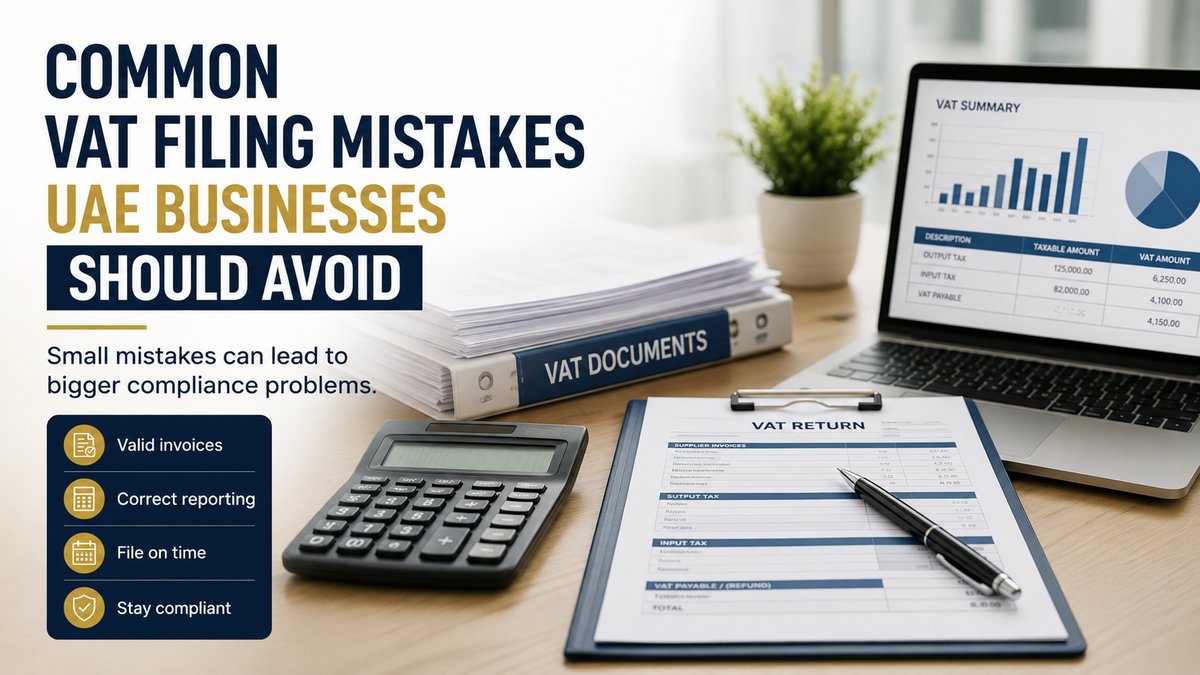
Learn the common VAT filing mistakes UAE businesses should avoid, including missing tax invoices, input VAT errors, bank reconciliation issues, and incorrect VAT return records.
VAT filing is a regular requirement for many businesses in the UAE, but it should never be treated as a simple formality. Every VAT return depends on the quality of the records behind it, including tax invoices, sales reports, purchase records, bank reconciliations, credit notes, and input VAT documentation.
Many VAT issues do not begin on the filing date. They usually start earlier, when invoices are missing, expenses are posted without proper support, sales are not matched with accounting records, or input VAT is claimed without enough review. By the time the return is due, the business may only be dealing with the result of gaps that have been building throughout the tax period.
A clean VAT return gives the business more than compliance. It creates better visibility, reduces the chance of unnecessary corrections, and helps business owners understand whether their records can support the figures submitted to the Federal Tax Authority.
This guide explains the common VAT filing mistakes UAE businesses should avoid and how better accounting controls can make each VAT return more accurate, organised, and defensible.
1. Treating VAT filing as a last-minute task
VAT filing becomes risky when the business only starts reviewing records close to the deadline. At that stage, the team may need to chase supplier invoices, check sales reports, reconcile payments, review credit notes, and confirm input VAT claims all at once.
This kind of pressure increases the chance of mistakes. A supplier invoice may be missed, a customer credit note may not be adjusted, or an expense may be included without the right tax document.
A stronger approach is to review VAT records during the tax period, not only at the end of it. Sales invoices, supplier bills, credit notes, and larger expenses should be checked regularly so that the final VAT return becomes a review process rather than a rushed clean-up.
2. Filing without reconciling bank accounts
Bank reconciliation is one of the simplest ways to detect VAT filing errors before they reach the return. It compares the transactions in the bank account with the entries in the accounting system and helps confirm that receipts, payments, refunds, transfers, and bank charges have been recorded correctly.
When reconciliation is skipped, the VAT return may be based on incomplete information. A customer payment may not be linked to the right invoice, a supplier payment may be posted without a bill, or a refund may be treated incorrectly.
For businesses with high transaction volumes, multiple bank accounts, online payments, or recurring supplier costs, reconciliation is especially important. It helps the finance team identify differences early and reduces the risk of missing sales, duplicate entries, or unsupported expenses.
3. Claiming input VAT without proper documents
Input VAT recovery is one of the most common areas where businesses make mistakes. Some companies assume that any expense with VAT can be claimed, but the claim needs to be supported by the correct documentation and the expense should relate to taxable business activity. A card receipt, payment confirmation, quotation, WhatsApp message, or supplier statement may not be enough on its own.
In most cases, the business should have a valid tax invoice that clearly supports the input VAT being claimed. This is where many VAT return problems begin. The accounting record may show that a payment was made, but the supporting invoice may be missing, incomplete, or not valid for VAT purposes.
A proper VAT return review should confirm whether input tax claims are supported, whether the expense is business-related, and whether the VAT amount has been recorded correctly.
4. Recording expenses with the wrong VAT treatment
Not every expense should be treated the same way for VAT. Some expenses include recoverable input VAT, some may include non-recoverable VAT, and others may not include VAT at all.
Mistakes often happen when expenses are posted automatically without checking the invoice. For example, VAT may be recorded even when the supplier has not charged VAT, or input VAT may be claimed on an expense that needs closer review.
Accounting software can help organise the data, but it cannot always decide whether the VAT treatment is correct. Human review is still needed, especially for unusual expenses, mixed-use costs, imports, entertainment-related costs, or transactions where the supplier invoice is unclear.
Correct expense classification protects the accuracy of the VAT return and helps the business avoid overstating input tax claims.
5. Using incomplete or incorrect tax invoices
Tax invoices are central to VAT compliance. If the invoice is missing important details, recorded in the wrong period, duplicated, or issued with an incorrect VAT amount, it can affect both the supplier’s output tax and the customer’s input VAT recovery.
Common invoice issues include missing TRNs, incorrect dates, wrong customer details, unclear descriptions, incorrect VAT calculations, or invoices that do not match the actual transaction.
These errors may look small at first, but they can create problems during VAT return preparation. A business may report output VAT incorrectly, claim input VAT without enough support, or struggle to explain differences between accounting records and VAT reports.
A good review process checks both sales invoices and supplier invoices before the return is submitted.
6. Missing credit notes, refunds, and adjustments
Credit notes are easy to overlook, especially when a business is dealing with customer returns, discounts, cancelled invoices, refunds, or price corrections.
If these adjustments are not recorded properly, the VAT return may overstate sales, understate adjustments, or create differences between the accounts and the VAT report. The same issue can happen when supplier credit notes are not matched to the original purchase invoice.
Adjustments should be reviewed as part of the normal VAT process. This includes checking credit notes, bad debt adjustments where relevant, corrected invoices, reverse charge entries, import VAT, and changes made after a previous filing.
The goal is to make sure the VAT return reflects what actually happened during the tax period, not just what was originally invoiced.
7. Mixing personal and business expenses
Owner-managed companies often run into VAT issues when business and personal expenses are not clearly separated. This can happen when the same bank card is used for company costs and personal spending, or when owner withdrawals are not recorded properly.
From a VAT perspective, this creates a risk because input VAT may be claimed on expenses that are not clearly connected to the business. Examples may include personal travel, personal subscriptions, family expenses, non-business meals, or purchases made through the company account without a clear business purpose.
Clean separation between business and personal expenses makes VAT filing easier. It also improves the quality of the company’s accounting records and reduces the chance of unsupported input VAT claims entering the return.
8. Not comparing the VAT return with accounting reports
A VAT return should agree with the company’s accounting records or, at minimum, any differences should be clear and explainable.
Problems arise when the VAT return is prepared separately from the main accounts. Sales in the VAT report may not match the revenue report, purchase figures may not agree with supplier records, or the VAT control account may show a balance that has not been reviewed.
These differences should not be ignored. Sometimes there is a valid reason, such as timing differences or adjustments, but the business should understand the reason before submitting the return. A proper VAT return review should compare output VAT, input VAT, VAT payable or refundable, sales reports, purchase reports, and the VAT ledger in the accounting system.
9. Recording transactions in the wrong tax period
Timing errors can affect VAT reporting, especially when invoices are entered late, supplier bills are received after the period closes, or transactions are recorded based only on payment date without reviewing the invoice date and tax point.
A sale recorded in the wrong period can affect output VAT. A supplier invoice entered late may affect when input VAT is claimed. If these issues happen often, the VAT return may not reflect the correct tax period.
A clear period-end process helps prevent this. The business should check which invoices belong to the period, which expenses should be included, and whether any late documents need to be reviewed separately.
This is especially useful for companies with recurring invoices, multiple branches, project-based billing, or high monthly transaction activity.
10. Leaving VAT compliance only to the finance team
Although VAT filing is usually handled by accounting or finance, the quality of the return depends on the whole business.
Sales teams issue invoices. Operations teams approve supplier bills. Managers approve expenses. Business owners make payments, transfers, and withdrawals. If these processes are not organised, the accounting team may not receive accurate information on time.
VAT compliance works better when the company has simple internal rules. Staff should know how invoices are issued, how supplier documents are collected, how expenses are approved, and when records need to be submitted for review.
This does not need to be complicated. A consistent process can reduce mistakes, improve document control, and make every VAT return easier to prepare.
How businesses can reduce VAT filing mistakes
Most VAT filing errors can be reduced with better monthly controls. The business does not need a complicated system, but it does need a consistent one.
A stronger VAT process should include regular bank reconciliation, proper invoice storage, review of input VAT claims, clear separation of business and personal expenses, accurate posting of credit notes, and comparison between VAT reports and accounting records.
It is also important to ask for professional review when the VAT treatment is unclear. This is especially true for mixed-use expenses, imports, reverse charge transactions, unusual supplier invoices, or adjustments that may affect more than one tax period.
Good VAT filing is not just about submitting the return on time. It is about submitting figures the business can support with proper records.
Get VAT filing support in the UAE
VAT filing should be supported by accurate records, valid tax invoices, and clear accounting reports. When the records are reviewed throughout the tax period, the final return becomes easier to prepare and less likely to contain avoidable errors.
If your business is preparing a VAT return, reviewing past filings, or trying to improve its VAT process, professional support can help identify issues before they become bigger compliance problems.
AMCME supports businesses in the UAE with VAT filing, VAT review, accounting, bookkeeping, corporate tax, and compliance advisory.
Contact us today to review your VAT records and prepare your next return with confidence.