Prepare for UAE corporate tax filing with this practical SME checklist covering financial statements, VAT records, bank reconciliation, payroll, expenses, and FTA record keeping.
Corporate Tax filing is now part of doing business in the UAE, and for many SMEs, the biggest challenge is not understanding that tax exists. The real challenge is knowing what to prepare before the filing deadline arrives.
A Corporate Tax return is not something a business should rush at the last minute. It is built from financial records, accounting reports, invoices, bank statements, expense documents, payroll records, and other supporting information that show how the business earned income and incurred costs during the tax period.
For UAE SMEs, preparation matters because Corporate Tax filing is not only about submitting a form. It is about making sure the numbers in that form can be supported if the Federal Tax Authority asks for clarification later.
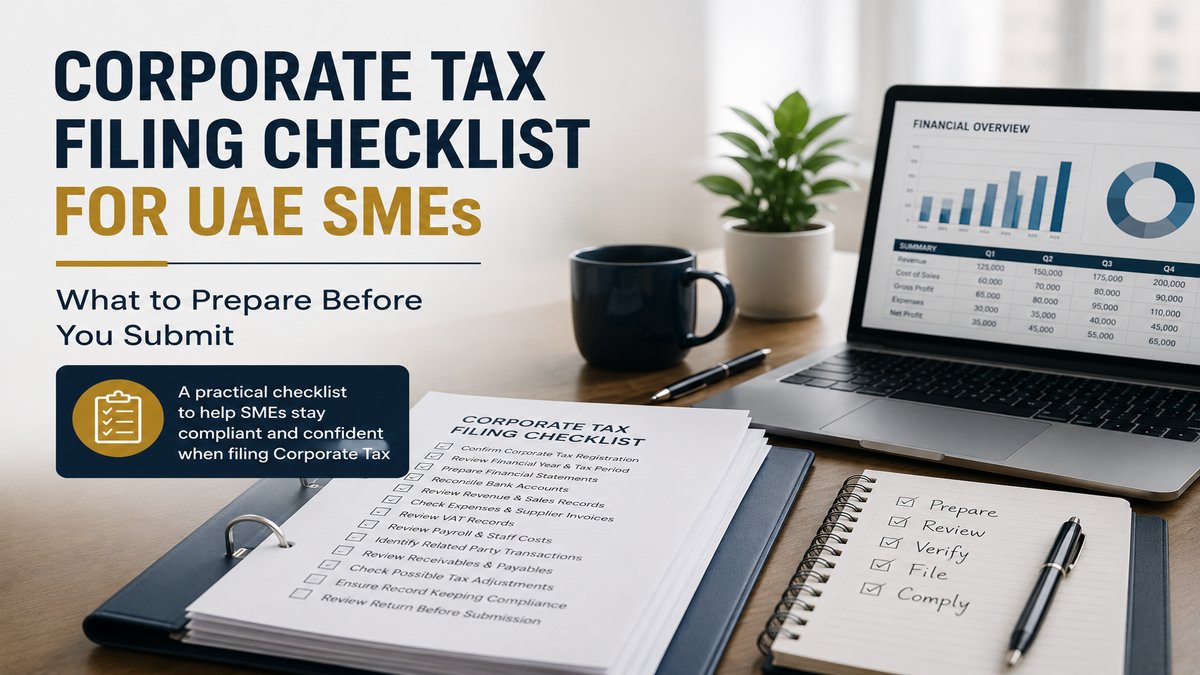
This Corporate Tax filing checklist for UAE SMEs explains what business owners should review before filing, why each item matters, and how proper accounting can reduce errors, delays, and compliance risk.
1. Confirm whether your business is registered for Corporate Tax
Before preparing a Corporate Tax return, the first question is simple: has the business completed its Corporate Tax registration?
Many SMEs assume registration and filing are the same thing, but they are separate compliance steps. A business may need to register for Corporate Tax before it is required to submit its return, depending on its legal structure, licence details, and tax period.
UAE companies, mainland businesses, and free zone entities should not assume that Corporate Tax does not apply simply because they are small, newly established, or operating from a free zone. Free zone companies are also within the scope of Corporate Tax, although qualifying free zone persons may benefit from a 0% Corporate Tax rate on qualifying income if the relevant conditions are met.
Before moving forward with filing, the business should confirm that its Corporate Tax registration is complete and that its details on the FTA portal are accurate. This includes the legal name, trade licence information, registered address, authorised signatory details, and contact information.
2. Check your financial year and tax period
Corporate Tax filing depends on the company’s tax period, which is usually linked to its financial year. For example, a business with a financial year ending on 31 December will have a different filing timeline from a company with a financial year ending on 30 June.
This is an important point because some SMEs prepare their accounts without paying close attention to the tax period that applies to the business. If the accounting records do not match the relevant tax period, the filing process becomes more complicated.
Before preparing the return, confirm the start and end date of the tax period, then make sure the accounting records cover that same period. This helps avoid missing revenue, duplicated expenses, or transactions recorded in the wrong financial year.
3. Prepare updated financial statements
Corporate Tax filing should be based on reliable financial statements. At minimum, SMEs should prepare a profit and loss statement and balance sheet for the relevant tax period. The profit and loss statement shows income, direct costs, operating expenses, and net profit or loss. The balance sheet shows assets, liabilities, equity, receivables, payables, bank balances, and other financial positions at the end of the period.
These reports help the business understand its taxable position before filing. They also help identify whether the accounts contain unusual balances, missing entries, unreconciled transactions, or expense categories that need review.
For many SMEs, this is where the filing process becomes difficult. If bookkeeping has not been maintained properly during the year, the financial statements may not be ready, accurate, or complete enough to support the Corporate Tax return.
4. Reconcile bank accounts before filing
Bank reconciliation is one of the most important checks before UAE Corporate Tax return preparation.
A bank reconciliation compares the transactions in the company’s accounting system with the transactions in its bank statements. This helps confirm that income, expenses, transfers, refunds, bank charges, and payments have been recorded correctly. If bank accounts are not reconciled, the financial statements may include missing sales, duplicated payments, unexplained withdrawals, or supplier payments that have not been matched to invoices.
For Corporate Tax filing, this matters because the return depends on the accuracy of the accounts behind it. A business should not file based on incomplete records or estimates when bank statements show that transactions have not been properly reviewed.
5. Review all sales and revenue records
Revenue should be reviewed carefully before filing a Corporate Tax return. This includes sales invoices, service income, project revenue, online payments, cash receipts, deposits, and any other income earned by the business during the tax period.
SMEs should check whether all sales invoices have been recorded and whether revenue has been recognised in the correct period. They should also review whether any credit notes, refunds, cancelled invoices, or bad debts have been treated correctly in the accounts.
This step is especially important for businesses that rely on manual invoicing, multiple payment channels, or informal tracking methods. If revenue is understated or recorded incorrectly, the Corporate Tax return may not reflect the true financial position of the business.
6. Check supplier invoices and business expenses
Expenses should be supported by proper documents, not just bank payments. A payment shown on a bank statement does not automatically prove that the expense is allowable, business-related, or recorded under the correct category.
Before filing, SMEs should review supplier invoices, receipts, contracts, payment confirmations, and expense claims. They should also check whether each expense is connected to the business and whether it has been recorded in the right accounting category.
Common issues include personal expenses recorded as business costs, missing supplier invoices, duplicated bills, vague descriptions, and expenses recorded without proper supporting documents.
Clean expense records help improve Corporate Tax filing accuracy and reduce the risk of questions later.
7. Review VAT records and tax invoices
For VAT-registered businesses, VAT records should be checked before Corporate Tax filing because VAT returns and accounting records should be consistent.
This does not mean VAT and Corporate Tax are the same. They are different taxes with different rules. However, the records used for VAT filing often overlap with the records used for accounting and Corporate Tax preparation.
Before filing Corporate Tax, businesses should review output VAT, input VAT, tax invoices, credit notes, VAT return summaries, and any adjustments made during the year. If the VAT returns show sales or purchases that do not match the accounting records, the difference should be investigated.
This step is useful because inconsistencies between VAT records and financial statements can indicate missing invoices, incorrect classifications, or timing issues that need to be corrected before filing.
8. Review payroll, WPS, and staff-related costs
Payroll records are another important part of the Corporate Tax filing checklist for UAE SMEs. Salaries, wages, allowances, end-of-service benefits, visa costs, medical insurance, staff reimbursements, and other employee-related costs should be properly recorded and supported.
Where applicable, businesses should also ensure that payroll records align with WPS records and employment documentation. This can help support salary expenses and reduce confusion when reviewing staff costs. Payroll issues often arise when payments are made outside the normal salary process, when reimbursements are not documented, or when staff advances are not separated from salary expenses.
Before filing, SMEs should check whether staff-related costs are complete, properly classified, and supported by the right records.
9. Identify owner withdrawals, personal payments, and related-party transactions
Many SME owners use the business account for mixed transactions, especially in smaller companies. This can create problems during Corporate Tax preparation.
Owner withdrawals, personal payments, shareholder loans, director expenses, and related-party transactions should be clearly identified and recorded correctly. These items should not be left as unexplained expenses or general payments in the accounts. This is important because Corporate Tax filing requires a clear view of the company’s actual business income and expenses. If owner transactions are not separated properly, the financial statements may become difficult to rely on.
Businesses should also review related-party transactions where relevant, especially where the company has dealings with owners, directors, group companies, or connected persons.
10. Confirm receivables and payables
Accounts receivable and accounts payable should be reviewed before filing. Receivables show amounts customers owe the business, while payables show amounts the business owes to suppliers and other parties. If these balances are not reviewed, the company may have old unpaid invoices, duplicated supplier bills, unrecorded payments, or balances that no longer reflect reality.
For SMEs, this step is important because receivables and payables affect the financial statements. They also help business owners understand cash flow and the quality of their records before filing. Before submitting the Corporate Tax return, businesses should check whether major customer and supplier balances are accurate and whether old outstanding amounts need to be reviewed.
11. Check whether any Corporate Tax adjustments may apply
Corporate Tax filing is not always a direct copy of the accounting profit. In some cases, adjustments may be required before taxable income is calculated.
These adjustments may relate to non-deductible expenses, exempt income, reliefs, related-party transactions, interest deduction rules, or other Corporate Tax treatments that depend on the company’s specific position.
This is where professional review becomes important. SMEs should not assume that accounting profit and taxable income will always be the same. A proper Corporate Tax review helps identify whether any adjustments are needed before the return is submitted.
12. Make sure records are complete and easy to retrieve
Corporate Tax compliance does not end after the return is filed. Businesses are expected to maintain records that support the information submitted.
This includes financial statements, invoices, contracts, bank statements, accounting ledgers, payroll records, tax calculations, VAT records, and other documents relevant to the tax period.
For UAE SMEs, good record keeping is not only about avoiding penalties. It also protects the business if it needs to answer questions, support a tax position, apply for financing, prepare for audit, or review past performance.
The best time to organise records is before filing, not after a request arrives.
13. Review the return before submission
Before submitting the Corporate Tax return, the business should complete a final review. This review should check whether the figures in the return agree with the financial statements, whether the tax period is correct, whether the company details are accurate, and whether the supporting documents are available.
The business should also check whether any payment is due and whether the filing is being completed within the required timeline.
A final review may seem simple, but it can prevent avoidable mistakes. Many filing errors happen because the return is prepared under pressure without enough time to check the numbers properly.
Why UAE SMEs should not leave Corporate Tax filing until the deadline
Corporate Tax filing becomes easier when accounts are maintained throughout the year. It becomes harder when a business waits until the deadline to clean up records, request missing invoices, reconcile bank statements, review VAT returns, and prepare financial statements.
For SMEs, last-minute filing can lead to unnecessary stress, higher accounting costs, incomplete records, and avoidable errors.
A better approach is to treat Corporate Tax as part of the monthly accounting process. When bookkeeping is updated, VAT records are reviewed, payroll is documented, and bank accounts are reconciled regularly, the Corporate Tax return becomes much easier to prepare.
Final checklist before filing
Before submitting your UAE Corporate Tax return, make sure your business has reviewed the following:
Corporate Tax registration status.
Correct tax period and financial year.
Updated financial statements.
Bank reconciliations.
Sales invoices and revenue records.
Supplier invoices and business expenses.
VAT records and tax invoices.
Payroll, WPS, and employee-related costs.
Owner withdrawals and related-party transactions.
Receivables and payables.
Possible Corporate Tax adjustments.
Supporting documents and record retention.
Final return review before submission.
Get Corporate Tax filing support in the UAE
Corporate Tax filing is not just about meeting a deadline. It is about submitting accurate information that your business can support with proper records.
If your accounts are not fully updated, if your VAT records do not match your books, or if you are unsure whether your financial statements are ready for filing, it is better to review everything before submission.
AMCME supports UAE businesses with accounting, bookkeeping, VAT, Corporate Tax filing, audit support, and compliance advisory.
Contact AMCME today to review your records and prepare your Corporate Tax return with confidence.