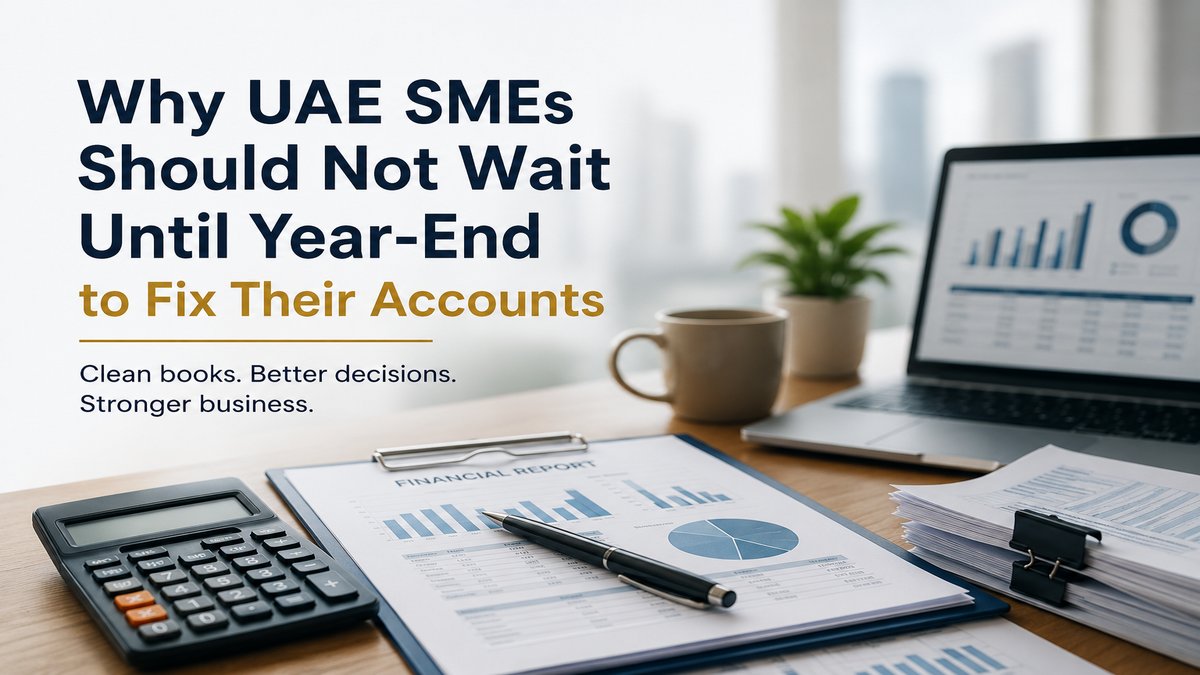
For UAE SMEs, accounting only becomes urgent when a deadline is approaching. But in 2026, clean books are no longer just a finance concern they are your first line of defence against FTA penalties, audit triggers, and tax errors.
For many UAE SMEs, accounting only becomes urgent when a deadline is approaching, but for UAE businesses, clean accounts are no longer just a “finance department” concern. They are part of tax compliance, audit readiness, business planning, and risk management. With Corporate Tax now part of the UAE business environment, companies need to treat accounting as a monthly discipline, not a year-end emergency.
Year-end accounting often reveals problems too late
When accounts are left until the end of the financial year, small issues can turn into major delays.
A missing supplier invoice may seem minor in March, but by year-end it can affect expense records, VAT treatment, and Corporate Tax calculations. An unreconciled bank statement may not feel urgent during a busy month, but when left unresolved, it becomes harder to identify which payments relate to which invoices.
This is where many SMEs struggle. The problem is not that the business has no records. The problem is that the records are scattered, incomplete, or not reviewed regularly enough to support accurate reporting.
By the time the company needs to prepare financial statements, file tax returns, or respond to a compliance request, the finance team may have to go backwards through months of transactions. That creates pressure, increases the chance of errors, and can make compliance more expensive than it needed to be.
Corporate Tax has made monthly accounting more important
Under the UAE Corporate Tax framework, businesses are expected to maintain proper records that support their tax position. The Federal Tax Authority has also stated that taxable persons and exempt persons must retain relevant records for at least seven years after the end of the tax period to which they relate.
This matters because a Corporate Tax return is not created in isolation. It is based on the company’s accounting records, financial statements, income, expenses, adjustments, and supporting documents.
If the books are unclear, the tax position becomes unclear too.
For SMEs, this means monthly accounting is no longer simply about knowing what came in and what went out. It helps the business understand:
whether revenue has been recorded correctly;
whether expenses are properly classified;
whether invoices and receipts are available;
whether VAT records are consistent;
whether related-party transactions need attention;
whether the company can support the numbers submitted in its tax return.
When these checks are done monthly, year-end becomes a review process. When they are ignored, year-end becomes a rescue mission.
VAT errors usually start before filing day
VAT filing problems often begin long before the return is submitted.
They may start with an incorrect tax invoice, a missing credit note, an expense recorded under the wrong category, or input VAT claimed without proper support. If these issues are not reviewed during the month, they can quietly carry forward into the VAT return.
This is why VAT compliance should not be treated as a quarterly task only.
A clean VAT return depends on the quality of the records behind it. Sales invoices, purchase invoices, credit notes, bank receipts, supplier payments, and expense documents all need to match the accounting records.
When businesses wait until the deadline, they are often forced to make decisions quickly. That is when errors are more likely to happen.
Monthly reporting helps business owners make better decisions
Good accounting is not only about compliance.
It also helps business owners make better decisions.
Many SME owners only look at revenue and bank balance. But those two numbers do not always show the full picture. A business can have strong sales and still struggle with cash flow. It can have money in the bank and still be carrying unpaid supplier bills, uncollected receivables, or tax liabilities that have not been planned for.
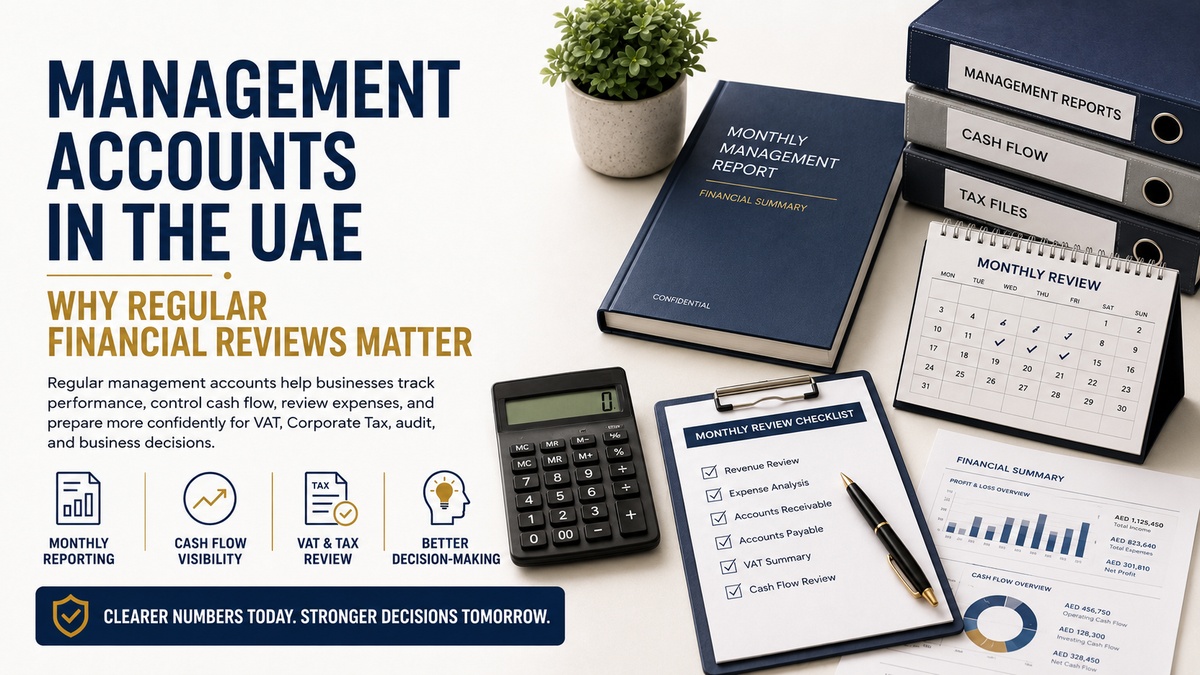
Monthly reporting gives business owners a clearer view of:
profit and loss;
cash flow;
outstanding receivables;
supplier payables;
VAT exposure;
payroll costs;
recurring expenses;
margins;
tax planning requirements.
Without monthly accounts, decisions are often made based on instinct rather than reliable numbers.
For a growing business, that can be risky.
Clean books make audit and financing easier
Businesses may also need proper accounts for reasons beyond tax.
Banks may request updated financial statements. Free zone authorities may ask for records. Investors, partners, or lenders may want to review the company’s performance. Some companies may also need audited financial statements depending on their size, structure, activity, or regulatory requirements.
When accounts are maintained properly throughout the year, these requests are easier to handle.
But when records are messy, every request becomes stressful. The business has to locate old invoices, explain missing entries, reconcile accounts, and correct mistakes under pressure.
This can delay financing, affect credibility, and create unnecessary operational stress.
The cost of fixing accounts late is often higher
Many SMEs delay accounting because they assume it saves money.
In reality, delayed accounting often becomes more expensive.
When accountants have to clean up twelve months of records at once, the work becomes more complex. There may be missing documents, duplicate entries, unexplained transactions, VAT inconsistencies, payroll gaps, or owner withdrawals that were not recorded clearly.
The longer the delay, the harder it becomes to fix.
Monthly accounting reduces this pressure because issues are identified while they are still fresh. A missing invoice can be requested immediately. A wrong entry can be corrected before it affects multiple reports. A VAT concern can be reviewed before filing.
This is why accounting should be seen as business protection, not just administration.
What UAE SMEs should review monthly
A strong monthly accounting process does not have to be complicated. But it does need to be consistent.
At minimum, UAE SMEs should review:
bank reconciliations;
sales invoices;
supplier invoices;
VAT records;
payroll and WPS records;
expense classifications;
accounts receivable;
accounts payable;
petty cash or owner-paid expenses;
supporting documents for major transactions;
management reports;
Corporate Tax impact where relevant.
The goal is not to make accounting harder. The goal is to prevent avoidable problems from building up quietly.
Do not wait until year-end to understand your numbers
Year-end should not be the first time a business understands its financial position.
By then, the company should already know whether its records are complete, whether its VAT position is clear, whether its expenses are properly supported, and whether its Corporate Tax filing is likely to be smooth.
For UAE SMEs, monthly accounting is now one of the smartest ways to stay compliant, reduce risk, and make better decisions.
Clean books give business owners confidence. If your business has not reviewed its accounts recently, now is the right time to start.
AMCME helps UAE businesses with accounting, bookkeeping, VAT, Corporate Tax, audit support, and compliance advisory.
Contact us today to review your accounts and prepare your business with confidence.